
How to Climb the WinPlay Premier League Leaderboard: A Football Knowledge Training Guide
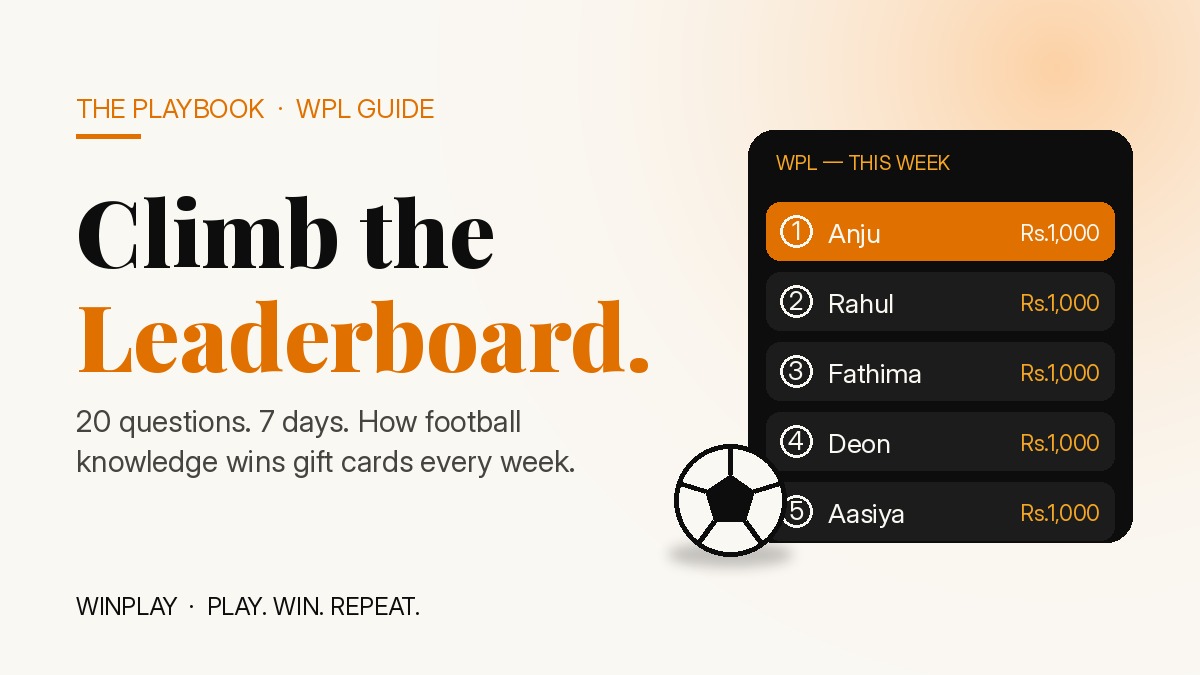
Every week, the WinPlay Premier League asks its players twenty football questions. That sounds simple until you sit down and realise how wide football knowledge actually runs — from a left-back’s transfer fee in 2019 to which country hosted a World Cup semi-final decades before you were born.
The players at the top of the leaderboard are not lucky. They answer well because they’ve built the kind of football memory that retrieves facts quickly and accurately under a ticking clock. That’s a skill — and like any skill, it can be trained.
This guide covers how the WPL works, why consistency beats brilliance, and how to build the football recall that puts you in the top ten.
First, know the rules that decide winners
The WinPlay Premier League is a weekly 20-question football quiz. Your answers build your score, your score sets your position, and at the end of the week the leaderboard pays out: the top five eligible players each receive a ₹1,000 gift card, and the next five receive ₹500 gift cards.
Notice the word eligible. This is the rule that catches more players than any hard question ever has: you must play at least five days in the week to be eligible for a prize. Every week, players finish inside the top ten on points and win nothing, because they only showed up three or four days.
The lesson is blunt: before you worry about knowing more football, make sure you’re playing enough days. A slightly lower score across five days beats a brilliant score across three, every single time.
Consistency is the real strategy
There’s a reason the same names keep appearing in the WPL winner posts. Regular players benefit from three compounding advantages.
First, they never lose points to absence. Twenty questions a week only matter if you actually answer them, and habitual players harvest every available point while occasional players donate theirs to the leaderboard.
Second, they get calibrated. Quiz performance improves with familiarity — question phrasing, pacing, the mix of eras and leagues the quiz draws from. By week three or four, regulars read questions faster and second-guess themselves less.
Third, they build streak memory. A fact you half-knew on Tuesday and got wrong becomes a fact you own the following week. Playing daily turns every mistake into a free lesson.
If you take one thing from this article: set a fixed time. Morning tea, lunch break, the bus home — anchor the quiz to something you already do daily, and the five-day rule takes care of itself.
Train your football memory like a footballer trains touch
Football knowledge feels like something you either have or don’t. That’s false. Recall is trainable, and quiz veterans use the same techniques across every trivia format.
Anchor facts to matches you watched. Memory researchers call this episodic anchoring — facts stick when they’re attached to an experience. You’ll never forget who scored in a final you stayed up to watch. So when you learn a new fact, tie it to a match, a moment, a feeling. “That was the season Leicester won the league” holds a dozen facts together in one memory.
Learn in clusters, not lists. Don’t memorise isolated trivia. Learn a whole cluster at once: one World Cup — host, winner, top scorer, the final score, one famous incident. Five facts stored as a story are easier to retrieve than five facts stored alone. Do one cluster a day and you’ve covered every World Cup since 1990 in under a month.
Cover the eras you didn’t live through. Most fans are strong on the last ten years and weak before it. Quizzes are not. Spend a little time on the classics: the great AC Milan and Barcelona sides, Maradona’s 1986, the 1999 treble, the legends of Indian football like I.M. Vijayan and Bhaichung Bhutia. The players who climb are the ones without blind spots.
Follow the numbers, not just the highlights. Goal tallies, appearance records, transfer records, Ballon d’Or years. Numbers are quiz gold because they have exactly one right answer. Ten minutes a week reading a records page outperforms hours of highlight reels.
Manage the clock, not just the question
Knowledge gets you most of the way; composure does the rest.
Read the whole question before your brain jumps to an answer. Football questions often turn on one qualifying word — European top scorer, international goals, league appearances — and fast readers lose points to questions they actually knew.
Trust your first instinct on recall questions. Decades of testing research show that on pure fact-retrieval, first answers are right more often than switched answers. Change your answer only when you genuinely remember something new, not because doubt crept in.
And when you don’t know, eliminate. Wrong options usually rule themselves out by era, league, or plausibility. Getting from four options to two doubles your chances on the hardest questions — and over twenty questions a week, those edges become leaderboard positions.
The Kerala advantage
If you grew up around football culture — the seven-a-side tournaments, the flag wars before every World Cup, the arguments over Argentina and Brazil that outlast the tournaments themselves — you already have a deeper football memory than you think. The WPL is where that lifetime of football talk finally counts for something.
Twenty questions. Seven days. Five days minimum to be eligible. The leaderboard resets every week, which means every week is a fresh chance to climb.
Play today’s questions at thewinplay.com — and while you’re there, try the daily Spot the Ball challenge, where one player wins a ₹1,000 gift card every single day.
WinPlay is a free-to-play skill-based gaming platform. No purchase, no entry fee — just skill. Play. Win. Repeat.